
This buyer’s guide explains how to move a bike across the United States with the lowest total cost while protecting its condition.
Specialty shippers like BikeFlights and ShipBikes use volume discounts and often beat carrier rates for ground transit. Example fares show ground moves from New York to nearby cities under $130, while USPS and direct carriers can cost much more for the same dimensions.
Readers will learn how box size, weight, and transit choice change final price. The guide favors ground options for the best value and explains when faster air services justify the higher fees.
For tailored advice or a quote, contact the support team at (307) 288-5972 or email info@bestcarshippinginc.com.
Key Takeaways
- Specialty companies often offer the best ground rates and balance of price and service.
- Dimensions and transit speed drive most of the final cost; pack smart to save.
- USPS can be viable for some routes; compare it against UPS/FedEx and brokers.
- Expedited air adds large premiums and is rarely cost-effective for standard moves.
- Include coverage, padding, and shop fees when budgeting total costs.
Buyer’s Guide Overview: How to find the cheapest way to ship a bike right now
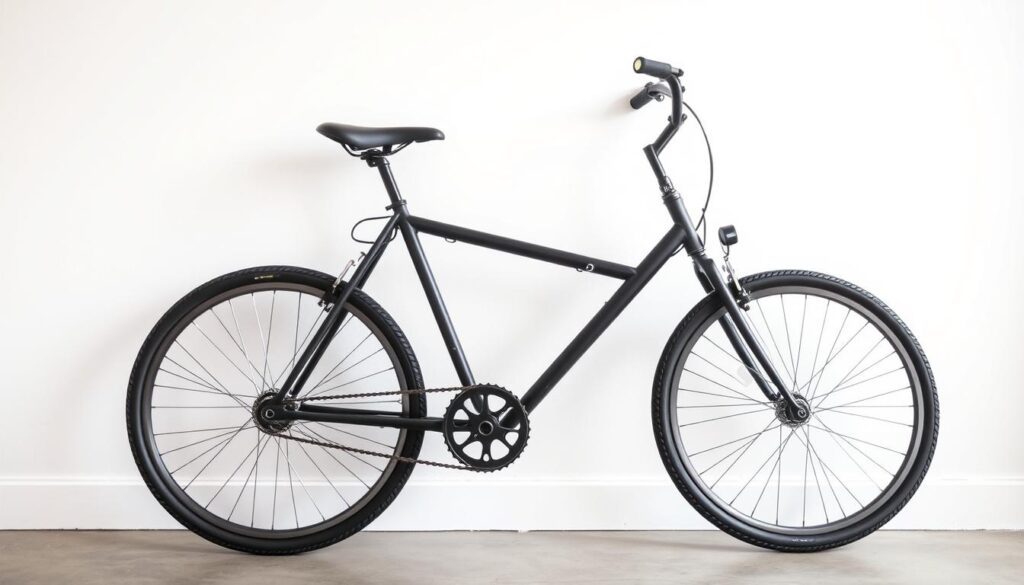
Ground freight often sets the baseline price, with specialty consolidators trimming margins through negotiated lanes. For many U.S. routes, published mid‑distance ground fares land in the $60–$120 range from specialty shippers. Direct UPS and FedEx ground often range $115–$230 depending on zone and dimensional rules.
USPS can post $200+ for standard 43 x 11 x 32 boxes on long routes. Expedited air rates rise sharply: Next Day and First Overnight services commonly start in the mid‑hundreds and can exceed $1,000 on long runs.
Quick planning checklist:
- Define your delivery window; flexible time keeps baseline shipping costs low.
- Get quotes using actual box dimensions and weight; dimensional weight often drives the final rate.
- Compare specialty consolidators against parcel carriers for your specific route and dates.
- Include pickup, residential delivery, signature, and insurance when totaling costs.
| Service Type | Typical Range (USD) | When to Use |
|---|---|---|
| Specialty consolidators | $60–$120 ground | Mid/long ground moves when time is flexible |
| UPS/FedEx ground | $115–$230 | Standard parcel lanes; watch dimensional weight |
| USPS | $200+ | Short regional moves or specific retail options |
| Expedited air | $338–$1,060+ | Races or urgent delivery when schedule outweighs cost |
Note: Plan outside peak season to avoid 10–30% surcharges. For e‑bikes, verify hazmat rules and expect battery surcharges. Document final quotes and pick the company that balances rate, protection, and delivery time.
Quick Cost Snapshot: Ground vs. Expedited vs. Specialty Shippers
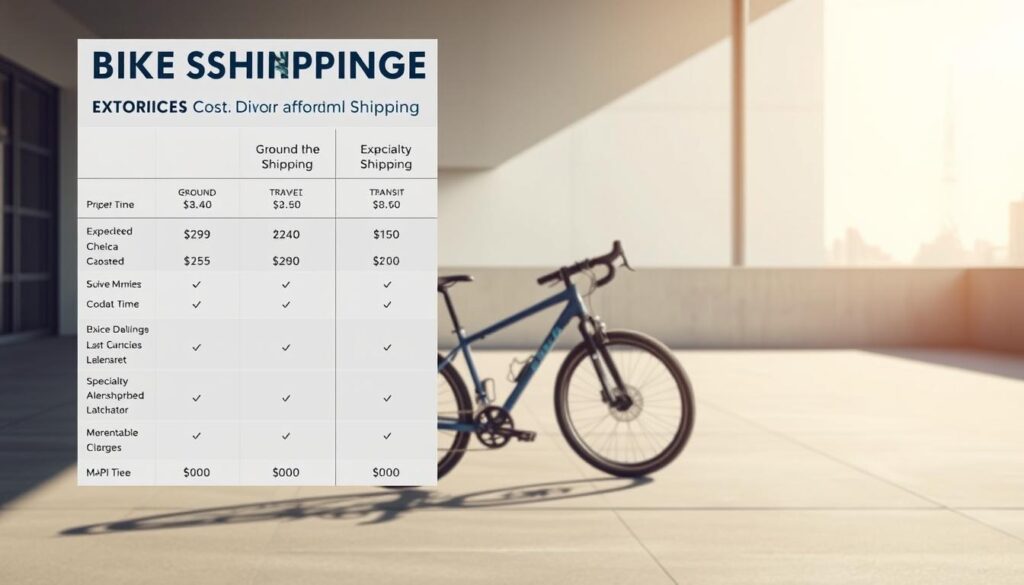
Comparing sample fares clarifies cost and time trade-offs across common lanes. Short regional moves may finish in one to three days on ground. Cross‑country ground runs often take five to nine days with consolidators.
Typical ground rates: BikeFlights, ShipBikes, UPS and FedEx
Sample quotes show specialty ground by BikeFlights at about $57, $78, and $101 for ~130, ~800, and ~2450 miles respectively. ShipBikes posts roughly $82, $104, and $127 on the same bands.
Direct parcel ground averages higher: FedEx Ground ~ $116, $151, $206 and UPS Ground ~ $132, $169, $227. USPS Ground Advantage trends above parcel lanes for the longest runs.
Speed trade-offs and when air makes sense
Air cuts transit to 1–2 days but multiplies price. UPS Next Day Air ranges from about $338 to $898 across the three distances. FedEx First Overnight runs even higher. BikeFlights Next Day often undercuts direct air rates.
Pay for air when a firm date or high-value event makes delay unacceptable.
Price bands by distance and service level
| Service | ~130 miles | ~800 miles | ~2450 miles |
|---|---|---|---|
| BikeFlights Ground | $56.97 | $77.71 | $100.89 |
| ShipBikes Ground | $82.06 | $104.20 | $126.60 |
| FedEx Ground | $115.56 | $151.47 | $206.04 |
| UPS Ground | $131.54 | $168.74 | $226.65 |
| USPS Ground Advantage | $134.65 | $203.05 | $278.85 |
- Rule of thumb: specialty ground often beats parcel ground by $30–$120+ on longer lanes.
- Plan box size to lower dimensional weight and reduce the effective rate.
- Compare declared value and pickup conditions for apples‑to‑apples rates.
Key Cost Drivers: Size, weight, zones, and declared value
Large-but-light bike packages usually price out based on dimensional weight rather than actual lbs. That makes box size the primary lever for lowering cost.
Dimensional weight vs. actual weight
Dimensional (billable) weight often exceeds the real weight for common boxes like 43 x 11 x 32 and 54 x 8 x 28 inches. Trim volume and the billable weight tier drops. That directly lowers the shipping charge.
Carrier limits and thresholds
Know hard limits. UPS and FedEx cap at 150 lbs, length 108 inches, and length plus girth 165 inches. USPS caps Retail Ground at 70 lbs and L+G 130 inches. Exceeding these triggers oversized fees or refusal.
Declared value, coverage, and insurance
Most carriers include about $100 of base coverage. Higher declared value raises fees. Specialty plans exist—BikeFlights and brokers offer extended protection for substantial value, often around $40+ for $3,000 coverage.
| Factor | Typical impact | Action |
|---|---|---|
| Dimensional weight | High — often governs rate | Right-size box; remove empty voids |
| Carrier limits | Medium — can cause surcharges | Measure length + girth; stay within limits |
| Declared value / insurance | Low–Medium — adds flat fee | Declare true value; buy supplemental coverage |
- Tip: Re-measure if unsure — one inch can change a tier.
- Note: Zones raise cost with distance even when weight and size are fixed.
Shipping Methods Compared: USPS, parcel carriers, consolidated freight, and specialty bike shippers
Choosing the right carrier depends on package limits, delivery guarantees, and whether the shipment needs special handling for parts and tires.
USPS Ground Advantage / Retail Ground
USPS will move packages under 70 lbs using Ground Advantage or Retail Ground. Long-haul costs for common bike boxes typically run in the $204.95–$278.85 range.
Note: oversized rules can add handling fees. Confirm weight and length+girth before booking.
UPS and FedEx parcel services
UPS and FedEx provide predictable delivery windows and broad pickup options. In our examples, FedEx ground ranged about $115.56–$206.04 while UPS ground ran $131.54–$226.65.
Next‑day air from these carriers often exceeds $750 on long routes. Use air only when speed justifies the higher cost.
Specialty bike shippers
BikeFlights and ShipBikes leverage volume discounts and streamlined handling. Sample ground fares ran roughly $56.97–$100.89 for BikeFlights and $82.06–$126.60 for ShipBikes.
These companies often simplify labels, tracking, and supplemental coverage for high-value builds.
Consolidated freight / LTL
Consolidated freight suits multi-item household moves. LTL pricing usually uses a minimum billable weight—commonly 120 lbs—so long‑lane samples landed near $436.48–$681.29.
Box size matters less for LTL; volume pricing and pallet rules govern cost instead.
- Compare end-to-end options: pickup, residential delivery, signature, and weekend policies.
- Confirm limits: dimensional rules and declared value affect final cost and refunds.
- For mixed needs: start with specialty ground, then check UPS/FedEx for short lanes or firm windows.
| Service | Sample Range (USD) | Best Use |
|---|---|---|
| USPS Ground Advantage / Retail Ground | $204.95–$278.85 | Compliant small/medium boxes; retail access |
| UPS Ground / FedEx Ground | $115.56–$226.65 | Predictable windows; national pickup network |
| Specialty bike shippers | $56.97–$126.60 | Cost-efficient ground moves; bike-focused services |
| Consolidated freight (LTL) | $436.48–$681.29 | Multi-item moves or palletized shipments |
The cheapest way to ship a bike
Volume-negotiated lanes and bike-focused workflows explain most savings with specialty shippers. Companies like BikeFlights and ShipBikes bundle many shipments, optimize labeling, and pass lower ground rates to customers. That typically places medium‑to‑long domestic ground fares in the $60–$120 band.
Why specialty shippers win: They combine discounted carrier contracts, simplified documentation, and optional bike-specific coverage. That reduces hidden fees and support friction when value and protection matter.
When parcel ground can compete
Short regional moves tighten the gap. For runs under a few zones, direct parcel rates may be similar; for example, FedEx Ground quoted about $115.56 for roughly 130 miles in sample data.
- Compare apples to apples: include pickup, residential, and declared‑value fees when quoting.
- Watch dimensional weight: a smaller box often cuts the billable tier and unlocks the true lowest rate.
- Tip: get two specialty quotes and one carrier quote for the same dimensions and date before booking.
Total Cost of Ownership: Boxes, packing, local bike shop services, and protection
Total ownership costs cover more than carrier fees. Box choice, padding, shop labor, and coverage add to the final cost. These elements determine the true value of any shipping plan.
Bike box and case options
Cardboard boxes remain popular. Expect to spend $100–$200 for a quality cardboard bike box or purpose-built box. Soft and hard cases cost more but improve protection for high‑value frames.
Packing materials and tools
Allocate $50–$150 for foam, bubble, tape, and protective wrap. Good packing prevents damage and reduces claims. Use foam tubing on the frame and wrap rotors and derailleurs.
Disassembly and local services
A local bike shop can disassemble and reassemble the bike for $50–$75. This fee buys expertise and saves time. Document condition with photos before handing the bike to the shop.
Coverage and insurance choices
Base carrier coverage typically includes about $100. For high‑value builds, premium protection of roughly $40+ for $3,000 declared value is common through specialty providers. Keep receipts for packaging and shop work when filing claims.
- Choose a sturdy cardboard box or case to balance protection and cost.
- Budget $100–$200 for boxes and $50–$150 for packing materials.
- Use a local shop for complex disassembly if tools or time are limited.
| Item | Typical Price (USD) | Why it matters |
|---|---|---|
| Cardboard bike box | $100–$200 | Right‑sized boxes lower dimensional weight and the cost shipping |
| Packing materials | $50–$150 | Reduces damage risk and claim exposure |
| Local bike shop labor | $50–$75 | Professional disassembly/reassembly saves time and prevents errors |
| Premium protection / insurance | $40+ | Needed for high replacement value and vendor gaps |
Final note: Add signature requirements for higher‑risk deliveries and retain receipts. These steps protect your investment and make total cost of ownership transparent.
Packing and Sizing Tips to Cut Costs without Cutting Corners
Trim the box dimensions wherever safe; small reductions in size often move the package into a lower billable tier.
Choose a cardboard box that fits padding and the frame without excess voids. Common workable sizes include 43 x 11 x 32 inches and 54 x 8 x 28 inches. Measure packed dimensions and weight before booking.
Right-sizing the box to reduce dimensional weight
- Minimize dimensional weight with the smallest safe box that fits your padding and parts.
- Use dense foam or cardboard panels to create crush zones at sides and fork tips.
- Weigh and measure the packed box so the quoted rate matches the final package.
Essential disassembly steps to meet carrier limits
- Remove front wheel, pedals, and seatpost; rotate or remove handlebars to cut length and girth.
- Protect the frame with foam sleeves and use dropout spacers.
- Shield or remove the rear derailleur and seal small parts in a taped bag inside the box.
- Slightly deflate tires and cap valves to reduce rim stress during handling.
- Reinforce seams and handles with quality tape and label all faces clearly for transit.
Final step: document condition with photos and keep packing receipts. These small actions lower cost and protect the shipment from damage.
By Bike Type: Road, mountain, kids’ bikes, and e-bikes
Not every bicycle travels the same; small changes in size or weight can shift you into a new rate tier. Road and mountain models often use the same box sizes, yet the billed dimensional weight—not just actual lbs—usually governs final pricing.
Road and mountain bike nuances:
- Road bikes are light but long; packed weights commonly land in the 24–35 lbs range for 54 x 8 x 28 or 43 x 11 x 32 boxes.
- Mountain bike builds add a few pounds and wider tires. Careful handlebar rotation and targeted padding for rotors and derailleurs cut risk without raising costs.
- Protect carbon frames with dense foam and rigid paneling to prevent crush and abrasion during handling.
Kids’ bikes:
Smaller frames often fit tighter boxes (for example, 43 x 8 x 24). That can unlock USPS Priority or lower ground rates for local bike moves. Even so, padding at contact points remains essential.
E‑bikes and batteries:
E‑bikes frequently weigh 50+ lbs and require ground‑only transport. Hazmat rules add surcharges—commonly around $30–$50 for batteries—and strict documentation is mandatory.
“Verify declared value and battery handling rules before booking; these items determine final costs and coverage.”
Confirm total packed weight and dimensions per bike type. The fit determines cost more than frame material. For high‑value builds, verify coverage and follow any manufacturer case recommendations for repeatable, safe packing.
Money-Saving Strategies for US Shipments
Booking early and avoiding peak holiday weeks often preserves the best ground rates and prevents surprise surcharges. Peak periods can lift prices 10–30%, so lock in quotes well before high season.
Plan ahead and compare options
Compare two specialty consolidator quotes with one direct ups fedex estimate for the same box dimensions. Specialty ground typically ranges $60–$120, while UPS/FedEx ground often sits between $115–$230 for similar lanes.
DIY disassembly vs. bike shop costs
Performing basic disassembly at home saves roughly $50–$75 versus a local bike shop. If tools or time are limited, pay the shop—its expertise can prevent damage and claim hassles.
Practical packing and pickup choices
Measure twice and right-size the box to lower dimensional weight and the final rate. Choose drop-off locations when possible; residential pickup can add fees and delay handoff.
Pro tip: checking as luggage
Checking your bike as airline luggage can be cheaper for long routes. It increases handling and storage risk, so plan ground transport at the destination and insure accordingly.
- Record quotes and dates: keep screenshots and booking IDs for quick pivots.
- Bundle options: consolidate declared value and signature requirements when comparing rates.
- Reuse materials cautiously: only if foam and panels remain rigid and intact.
“If transit days are flexible, select standard ground rather than premium air; time often buys substantial savings.”
International Shipping Considerations and Costs
Cross-border transport introduces extra fees, paperwork, and longer transit windows. Planning reduces surprises and protects value during global moves.
Cost ranges by route: expect wide variability. Canada lanes commonly run from about $206 up to $934+ depending on speed and carrier selection.
Transatlantic routes can exceed $1,000. Example ranges for Europe span roughly $455–$2,169 in sample data. BikeFlights often posts lower international rates than direct UPS or FedEx on comparable lanes.
Documentation, duties, and insurance steps
Confirm whether quotes include duties, taxes, and customs clearance. Many calculators omit these charges; unpaid duties become immediate extra costs.
Prepare a commercial invoice, declared value (for example $3,000 for high-value builds), accurate contents, and serial numbers. Record photos of the package and frame; they ease claims and customs checks.
Carrier and routing options to compare
Keep package dimensions tight. Oversized lengths or L+G over limits can disqualify services or trigger surcharges.
Practical checklist:
- Compare international rates and transit windows across carrier and specialty companies.
- Evaluate insurance and supplemental coverage for multi-leg handling.
- Where allowed, ship batteries separately and choose ground-only battery options to simplify hazmat compliance.
- Align delivery windows with customs cycles to avoid storage fees and delays.
Work with experienced firms when possible. Companies familiar with cross-border bike logistics reduce handling events and unexpected delays. For a practical guide on related transport options, see our motorcycle shipping guide.
Conclusion
For most U.S. routes, specialty consolidators deliver the best balance of price and careful handling.
Specialty ground through BikeFlights and ShipBikes usually lands in the $60–$120 band. For short regional runs, compare direct UPS/FedEx ground as rates can be close. Air options cut transit to 1–2 days but add a large premium.
Plan total cost: a quality bike box ($100–$200), packing ($50–$150), local shop labor ($50–$75), and supplemental insurance or hazmat fees for e‑bikes. Control weight and size to avoid dimensional upcharges and protect the frame.
Keep photos, serial numbers, and receipts. For hands‑on packing help, your local bike shop can prepare the package professionally. When ready, call (307) 288-5972 or email info@bestcarshippinginc.com for tailored guidance and quotes.