
Enclosed auto transport is the premium choice for owners who need a car kept car safe from weather, road debris, and public handling. In Canada, winter road salt and freezing rain add real risk on open carriers, making this option a clear protective choice.
Industry research notes average enclosed pricing near $1,500 depending on route and timing. That higher cost reflects added shielding, fewer touch points, and often more reliable scheduling for high-value vehicles.
The page guides vehicle owners comparing options. It focuses on risk reduction, scheduling reliability, and professional customer care. Car shipping decisions hinge on vehicle value, season, route distance, rural access, and timeline flexibility.
Professional carriers document condition at pickup and delivery. Insurance applies during active transit under the carrier’s responsibility window. For pricing and dispatch availability, contact info@bestcarshippinginc.com or call (307) 288-5972. Learn more about our options at enclosed car shipping.
Key Takeaways
- Protection: This method keeps a car shielded from weather and debris.
- Cost vs. value: Higher price often pays off for high-value vehicles.
- Canadian winters: Salt and severe weather justify the extra care.
- Decision factors: Consider vehicle value, season, route, and timeline.
- Trust: Car condition is documented; insurance covers transit window.
- Action: Request pricing by email or phone for immediate availability.
What Enclosed Transport Is and How It Protects Your Vehicle
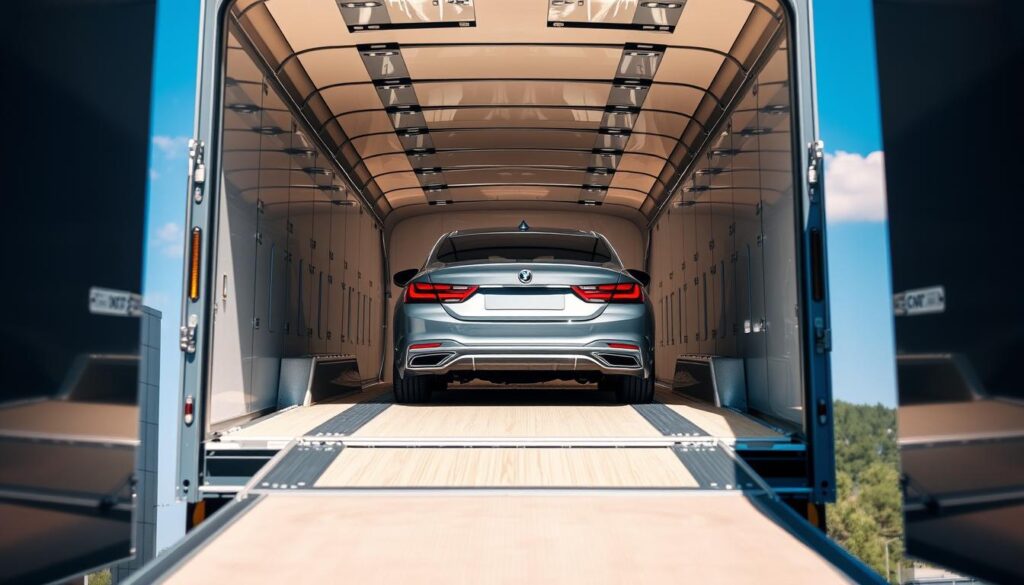
When a vehicle travels inside a sealed trailer, paint and glass face far less risk from gravel and salt. A covered trailer keeps cars out of wind, rain, dust, and flying road debris.
How inside protection works
Fully covered space means the vehicle stays inside a sealed area that blocks weather and common road debris. That inside vehicle environment reduces exposure to snow, ice, and salt on Canadian highways.
Fewer moves, lower handling risk
Operators load fewer vehicles per run. Fewer stops mean fewer loading events and less public handling compared with open carriers. That lowers theft and accidental damage risk.
Equipment and securement practices
Professional trailers use lift gates or low-angle ramps for low-clearance cars. Vehicles are secured with soft wheel straps—on the wheels, not the suspension—and wheel chocks and padding as needed. These methods protect bodywork during long routes.
| Feature | Enclosed Trailer | Open Carriers |
|---|---|---|
| Weather protection | High | Low |
| Exposure to road debris | Minimal | Frequent |
| Handling events | Fewer stops | More stops |
| Securement standard | Wheel straps & chocks | Mixed methods |
When Enclosed Auto Transport Is Worth the Extra Cost
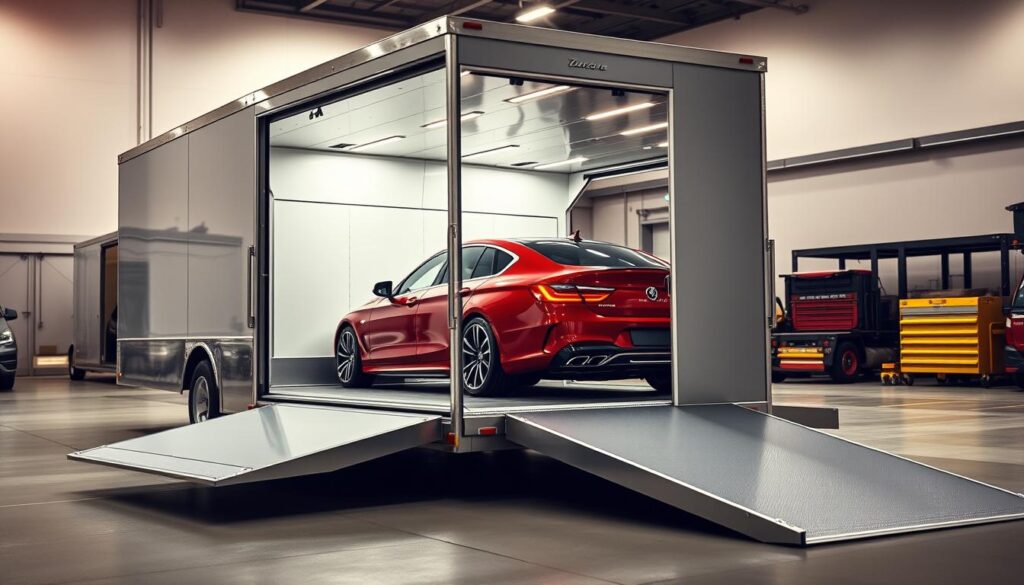
For many collectors, the extra fee is a calculated investment in preserving value during interprovincial moves.
Best-fit vehicles include luxury models, exotic builds, a classic car with original paint, collector cars, and hot rods with custom finishes or low clearance.
Why owners pay more
Higher fees buy reduced exposure, specialized equipment, and tighter controls. That tradeoff limits scratches, salt pits, and gravel chips that appear on open runs.
Risk and insurance
Fewer handling events lower claim likelihood. Tighter handling practices also support clear insurance coverage outcomes if a rare or freshly restored vehicle is affected.
When to choose this option
- Relocation of a prized vehicle across provinces.
- Auction or dealership delivery where condition matters.
- Seasonal storage moves and long-distance trips in winter.
Plan time to allow consolidation and flexible pickup windows. Proper scheduling often reduces cost without sacrificing protection.
Enclosed vs Open Transport in Canada: Key Differences Buyers Should Know
Buyers should match protection level to their car’s value and the season. This short comparison clarifies how each option handles debris, salt, access, and winter weather.
Protection comparison: debris exposure, salt, dust, and severe weather
Enclosed shipping offers full weather protection and blocks most road debris and dust. It limits salt exposure that can accelerate corrosion on brakes, exhaust, and the undercarriage.
Open transport leaves vehicles exposed to rock chips, airborne grit, and wind-driven slush. That increases the risk level for finishes and mechanical components in winter.
Security and access: inside vehicle shielding vs open carriers
An enclosed trailer reduces visibility and public access to the car. This is important for high-end vehicles and discreet deliveries. Open carriers are visible and easier to inspect at stops.
Risk summary and guidance for buyers
- Open transport is standard for everyday cars and tight budgets.
- Enclosed shipping is often recommended for winter moves and high-value vehicles.
- Choose open carriers when price matters and the route is mild. Choose higher protection when corrosion or cosmetic damage would be costly.
Ready to decide? Request a quote by emailing info@bestcarshippinginc.com or calling (307) 288-5972.
How Enclosed Auto Shipping Works Door-to-Door
A structured door to door workflow keeps a vehicle protected and documented at every step.
Quote & dispatch. Customers provide vehicle details, operability, pickup and delivery addresses, and preferred timing. Route planning sets a pickup window and assigns a vetted carrier. At dispatch, drivers’ contact information and preparation instructions are sent to the customer.
Pickup inspection. A condition report is completed and recorded on the Bill of Lading. This creates the baseline record for claims and final comparison.
Loading and securement. Vehicles load via lift gate or ramp into a sealed trailer. Carriers use soft wheel straps (not suspension), chocks, and padding for low-clearance or delicate finishes.
Transit updates and urban delivery. Customer service coordinates status updates with drivers and provides ETA changes. For tight streets, carriers plan a nearby safe meeting point to save time and avoid delays.
Delivery inspection. The recipient compares the vehicle to the original Bill of Lading before signing. Only after condition verification is paperwork completed.
| Step | What to expect | Who provides info |
|---|---|---|
| Quote | Estimate, pickup window | Customer |
| Dispatch | Driver contact, route planning | Carrier |
| Pickup | Condition report on Bill of Lading | Driver & customer |
| Transit | Status updates from customer service | Drivers |
| Delivery | Final inspection and signature | Customer & carrier |
Enclosed Car Shipping Costs in Canada and What Affects Pricing
Pricing for covered car moves varies widely across Canada and reflects distance, season, and vehicle specifics. Buyers should view shipping costs as a reflection of equipment limits, lane capacity, and added protection.
Typical pricing factors
- Distance: Longer routes raise base rates and fuel surcharges.
- Vehicle size and height: SUVs and trucks reduce trailer capacity and cost more to ship.
- Operability: Non-running vehicles need winches and more time, increasing the cost ship total.
- Rural access: Remote pickups add time and mileage to a run.
- Timing: Expedited requests or winter demand raise shipping costs.
Sample route ranges and transit times (CAD)
| Route | Price range | Transit time |
|---|---|---|
| GTA local | $450–$850 | Same/next day |
| Toronto → Ottawa | $900–$1,300 | 1–2 days |
| Toronto → Vancouver | $3,200–$4,800 | 7–10 days |
| Ottawa → Calgary | $2,800–$4,200 | 6–9 days |
“Provide full vehicle dimensions and modification details up front to avoid quote changes and protect dispatch timing.”
For a detailed quote and to compare options, request a premium service estimate at premium enclosed car transport services or contact info@bestcarshippinginc.com.
Insurance Coverage, Liability, and What “Responsibility During Transport” Means
Knowing the limits of carrier responsibility helps customers make confident shipping choices. This section explains what carrier cargo insurance usually covers and when the carrier is legally responsible for a vehicle.
What carrier cargo insurance usually covers during active transit
Carrier cargo insurance generally covers physical damage that occurs while the car is in the carrier’s possession. That includes collision, weather-related damage, and road debris that happen during transit.
When the carrier is responsible
Responsibility during transport begins at pickup when the customer signs the Bill of Lading. It ends after the delivery inspection is completed and recorded. The signed Bill of Lading is the baseline for any claim.
Common exclusions and practical realities
Carriers do not normally cover pre-existing mechanical issues. Personal items left inside the vehicle are also excluded. Customers should document condition and remove valuables before pickup.
| Item | Covered | Notes |
|---|---|---|
| Physical damage in transit | Yes | While in carrier possession; documented by Bill of Lading |
| Pre-existing issues | No | Not covered; document during pickup |
| Personal items | No | Remove valuables before pickup |
| Weather and debris | Yes | Less exposure lowers claim likelihood |
How covered trailers reduce claims: Controlled loading, correct securement, fewer handling events, and reduced exposure to salt and grit cut the risk of damage.
Quick checklist for customers:
- Make sure you review insurance limits before pickup.
- Keep copies of the Bill of Lading and photos from pickup and delivery.
- Perform a detailed inspection at both endpoints and note discrepancies immediately.
For help reviewing carrier coverage or to arrange a protected move, contact the team or request a quote for car shipping and auto transport in Upton at car shipping and auto transport in. Email info@bestcarshippinginc.com or call (307) 288-5972.
Choosing the Right Enclosed Carrier or Service Team in Canada
Selecting the right carrier or managed service can cut delivery risk and simplify cross‑province moves.
Trust signals matter. Look for companies with at least 10+ years experience, stable leadership, and reviews that praise on‑time pickups and careful handling.
Verify carrier vetting steps before booking. Confirm licensing and authority for the required routes. Ask for insurance limits and recent safety records.
Driver standards and company checks
Good teams maintain strict driver standards. That includes valid commercial licenses, regular safety audits, and documented training. Drivers should use soft wheel straps and chocks for securement.
Customer service expectations
Expect proactive updates, clear escalation paths, and a service team that coordinates changes and resolves issues quickly. Guaranteed pickup dates and enhanced tracking are strong differentiators.
| Selection Factor | What to ask | Why it matters |
|---|---|---|
| Years experience | How long has the company operated? | Longevity signals stability and fewer broker turnovers |
| Carrier vetting | Can you show licensing and insurance? | Verifies legal authority and financial protection |
| Customer service | How are updates provided? | Protects timelines and reduces confusion |
Practical tip: Ask who will be the carrier, what equipment they will use, and the pickup window. For a trusted option and more details about car transport, visit car transport services.
Where Enclosed Vehicle Transport Runs in Canada: Common Routes and Coverage
Most long-haul lanes cluster between Ontario and western provinces, creating regular schedules for protected car shipping.
Across-province moves are common from Ontario to Western Canada. These runs reduce exposure on long routes and are often consolidated to keep handling low.
Lane density matters. High-density corridors offer more frequent service and better pricing. Low-density lanes need interlining or scheduled pick-ups and can take longer.
Across-province and interprovincial shipping: Ontario to Western Canada and beyond
Ontario to Western Canada is a primary lane for enclosed vehicle transport. Carriers consolidate loads to lower cost and cut handling events on long routes.
Western coverage example: BC and Alberta networks and interlining to SK/MB
Precision Carriers Ltd. covers much of BC and Alberta and interlines to Saskatchewan and Manitoba. That lets carriers extend service to SK/MB when direct lanes are limited.
City and region examples: GTA, Ottawa corridor, Southwestern and Northern Ontario
Ontario coverage includes the GTA (Toronto, Mississauga, Brampton, Vaughan, Markham), the Ottawa corridor (Ottawa, Kingston, Cornwall), Southwestern Ontario (London, Windsor, Kitchener, Waterloo), and Northern Ontario (Sudbury, North Bay, Thunder Bay).
“Plan early: seasonal demand shapes carrier availability and dispatch options.”
Practical notes:
- Consolidated routes mean fewer stops and lower handling risk for vehicles.
- Seasonal peaks (winter and spring moves) change pricing and availability.
- Provide exact pickup and delivery postal codes to confirm carrier coverage and realistic transit times.
| Route | Coverage pattern | Why it matters |
|---|---|---|
| Ontario → BC/Alberta | Frequent long-lane runs | Lower handling, common for long-distance car shipping |
| BC/Alberta → SK/MB | Interline agreements | Extends service to lower-density destinations |
| GTA & Ottawa corridor | High lane density | More schedule options and competitive rates |
| SWR & Northern Ontario | Regional pickups | May require consolidation; allow extra lead time |
Next step: Share your route details for a tailored car shipping plan and realistic transit expectations. Email info@bestcarshippinginc.com or call (307) 288-5972.
Preparing Your Car for Enclosed Shipping to Avoid Delays
Careful pre-shipment checks keep pickups on schedule and claims rare. Follow a few clear steps to make sure the driver can load your car quickly and without surprises.
Pre-pickup readiness
Fuel level: Leave about a quarter tank to reduce weight while allowing movement.
Battery & tires: Confirm the battery is charged and tires are inflated to the recommended pressure.
Mirrors & keys: Fold mirrors where possible and have one set of keys ready for the driver.
Personal items and compliance
Remove personal items. Carriers are not licensed to carry household goods. Clear loose cargo to avoid delays and claims.
Disable toll tags and parking passes to avoid incidental charges while the vehicle moves.
Photo documentation and special vehicles
Take clear photos from all angles and note existing chips or scratches before pickup inspection.
If the vehicle is non-running, low-clearance, or modified, notify customer service in advance so appropriate ramps or a lift gate can be scheduled.
| Item | Action | Why it matters |
|---|---|---|
| Fuel level | ~1/4 tank | Reduces weight and allows repositioning |
| Battery & tires | Charged battery; tires inflated | Prevents delays due to inoperable vehicle |
| Personal items & tolls | Remove items; disable toll tags | Compliance and prevents charges |
| Documentation & mods | Photos; flag low-clearance/modified | Supports claims and ensures correct equipment |
Need written instructions? Customer service can send preparation information and a pickup checklist. Contact info@bestcarshippinginc.com or call (307) 288-5972 to confirm details and save time at pickup.
Conclusion
Conclusion: Opt for enclosed auto transport when protection and condition matter most. This choice best fits an owner moving a high-value car across long or winter routes.
Covered shipping outperforms open runs by shielding paint and undercarriage, cutting debris and salt exposure, and reducing handling events. Professional teams document condition at pickup and delivery with a Bill of Lading and maintain clear carrier responsibility during transit.
To proceed, request a quote and share vehicle details, route, and timing so the team can confirm whether they can provide enclosed service for your plan. Contact Best Car Shipping Inc. at info@bestcarshippinginc.com or (307) 288-5972 to schedule secure car shipping with responsive customer service.