
Secure vehicle shipping delivers business-grade protection for high-value cars in Canada. This service uses hard-sided trailers, GPS tracking, and soft-tie securement over tires to prevent damage during transit.
Interior safeguards like seat and steering wheel covers, plus lift-gate or low-angle ramp loading, reduce risk for low-clearance models. Customers can expect clear handling standards, insurance details, and coverage maps up front.
Typical buyers include private owners, luxury dealers, auction purchasers, and logistics coordinators. In practice, secure shipping means less exposure to weather, road debris, and public handling, with reliable communication and traceable processes.
Readers will later see how trailer type, loading method, tie-down approach, driver qualifications, and insurance affect outcomes. For a tailored quote and scheduling, request a quote or contact the team at info@bestcarshippinginc.com or (307) 288-5972.
Key Takeaways
- Highest protection: Hard-sided trailers and interior covers limit damage.
- Transparent service: Tracking, insurance, and handling standards are provided.
- Loading options: Lift-gates and low-angle ramps protect low-clearance vehicles.
- Who uses it: Private owners, dealers, auction buyers, and coordinators.
- Decision factors: Trailer type, tie-down method, driver credentials, and coverage matter.
- Next step: Request a quote to confirm routing, timing, and protection details.
Premium Enclosed Vehicle Shipping in Canada for High-Value Cars

High-value cars demand a shipment method that reduces exposure to road wear and public view. This service is ideal for owners who need discrete, measurable protection during long Canadian routes.
Who benefits most
Exotics, antiques, collector vehicles, prototypes, and low-clearance car models qualify first. These profiles face higher risk from salt, gravel, and ramp contact.
Why clients choose this service
Lift-gate and low-angle ramp loading reduce undercarriage strikes on low-clearance vehicles. TFX International and MVS Canada note this capability for non-running and prototype vehicles.
“Hard-sided trailers cut exposure to salt, sand, and road debris while keeping the vehicle out of sight for added discretion.”
- Measurable protection: Reduced exterior wear and lower claim risk.
- Interior care: Covers and careful handling preserve showroom condition.
- Canadian realities: Winter roads and long hauls see fewer surprises at delivery.
For a tailored plan that matches vehicle specifics and delivery timelines, see our premium enclosed car transport services.
What Sets Top enclosed auto transport companies Apart
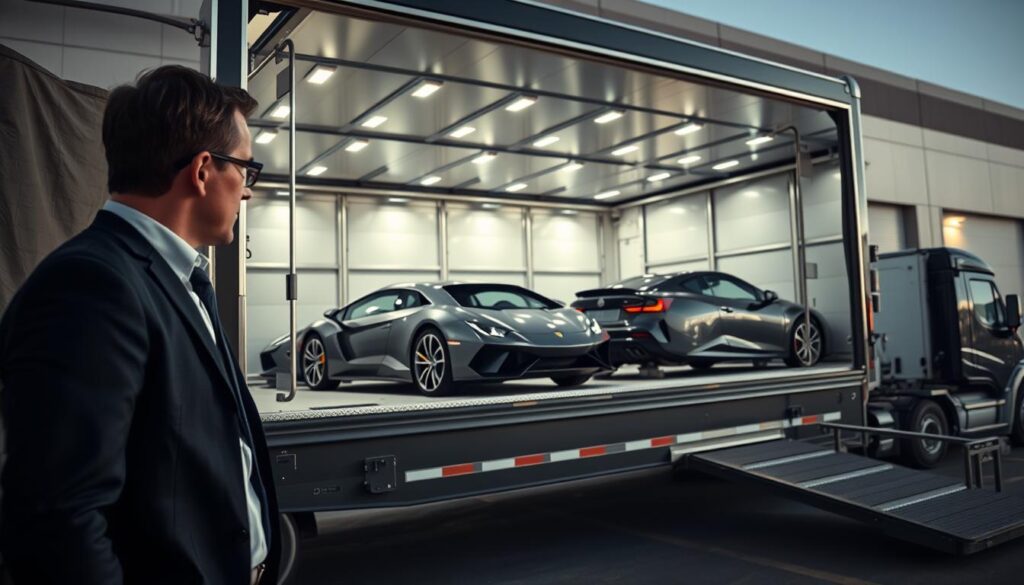
Top carriers use hard-sided trailers and rigorous handling standards to keep high-value vehicles out of view and out of harm’s way.
Hardware and loading
Hard-sided trailers provide an out-of-sight layer of security and block weather and debris. Some units carry up to six vehicles while preserving privacy and finish.
Fully hydraulic lift gates matter for low-clearance models. When lift gates are not available, long low-angle ramps reduce undercarriage contact.
Ride quality and securement
Air-ride trailer design cuts vibration and road shock. This protects delicate suspension setups and high-value paint.
Soft strap tie-downs over tires are standard. Reputable firms avoid chains on the frame to prevent harm.
Protection, visibility, and human standards
Interior protection packages typically include seat covers, steering wheel covers, and floor mats to keep delivery condition consistent.
GPS tracking and online visibility let customers and coordinators plan receiving windows and follow progress in real time.
Top operators use company-employee drivers with documented procedures. That personnel model lowers handoff risk and shows measurable experience.
| Feature | Standard Benefit | Why it matters |
|---|---|---|
| Hard-sided trailers | Weather and debris protection | Preserves finish and privacy |
| Hydraulic lift gates / ramps | Safe low-clearance loading | Reduces undercarriage damage |
| Air-ride design | Reduced vibration | Protects suspension and trim |
| Soft strap securement | No frame chains | Prevents scrapes and dents |
For a detailed route quote and scheduling, see our interstate vehicle shipping page.
Enclosed Transport Services Available Today
Today’s service lineup covers door-to-door pickups for homes, businesses, and dealer lots across Canada.
Door-to-door for residences, commercial sites, and dealers
Door service means pickup at the address you provide. Carriers coordinate timing to minimize wait and to respect property access rules.
White-glove handling for showroom and auction purchases
White-glove describes careful scheduling, protective coverings, controlled loading/unloading, and step-by-step communication. This level suits showroom vehicles and Bring a Trailer wins.
Special handling for non-running vehicles and prototypes
Operators use pushers and winch procedures when engines can’t run. Drivers avoid unnecessary starting, idling, or road exposure to protect prototypes and non-running models.
Standby and dealer service moves
Standby options support time-sensitive shop appointments, event deliveries, and quick dealer handoffs. These moves are planned to match appointment windows and reduce last-minute risk.
- Service availability depends on trailer fit, vehicle size, and route planning.
- Professional carriers confirm constraints before dispatch to prevent surprises.
“These service formats act as risk-management tools, ensuring consistent results rather than improvisation on pickup day.”
Contact: info@bestcarshippinginc.com | (307) 288-5972
How Enclosed Vehicle Transport Works From Pickup to Delivery
A clear, step-by-step plan before pickup cuts day-of delays and protects vehicle condition.
Pre-shipment planning
Teams confirm the vehicle’s dimensions, condition, and special needs. They verify trailer fit and set a scheduling window that reflects routing realities.
Tip: Provide accurate photos and details when you request a quote to speed planning.
Professional loading
Drivers use hydraulic lift gates for low-clearance models. Ramps work for standard ground clearance cars. Each method aims to avoid undercarriage contact.
Securement and in-transit care
Nylon soft straps secure tires and control movement. Vehicles ride on air-ride trailers to limit vibration and reduce exterior wear inside the enclosed trailer.
Routing realities and access
Carriers may route vehicles through terminals with first-come pickup windows. Direct shipping is chosen when speed and single-leg control matter.
Large trucks may stage nearby when streets or cul-de-sacs block access. Drivers then coordinate a safe meeting point.
Insurance and delivery
MVS Canada lists automatic coverage up to $300,000 and options to increase limits for higher-value vehicles. At delivery, the driver performs a final inspection, documents condition, unloads carefully, and completes a professional handoff.
- Confirm specs early to avoid hold-ups.
- Choose lift-gate loading for low-clearance cars.
- Expect terminal routing unless direct shipping is requested.
For specific routing and a tailored car shipping quote, contact the team.
Service Areas, Routes, and Cross-Border Canada-US Transport
Frequent runs between Vancouver, Kelowna, Calgary, Edmonton, Regina, and Winnipeg create predictable timing for most vehicle shipments.
Western Canada coverage and frequent lanes
Core lanes across BC, Alberta, Saskatchewan, and Manitoba set the foundation for reliable transport. Regular Vancouver–Kelowna, Vancouver–Calgary, and Vancouver–Edmonton runs reduce waiting time.
Aligning a vehicle’s pickup with these lanes often lowers cost and shortens lead time. Frequent schedules let planners confirm windows and manage expectations.
Remote and specialty destinations
Vancouver Island and Northern BC require extra planning. Out-of-the-way pickups like Kitimat, Prince Rupert, Whitehorse, Fort Nelson, Fort McMurray, and Grande Prairie are serviced on request.
These locations need added routing time and handling steps to protect the vehicle and meet customer needs.
Canada–US operational support
Cross-border moves include documented customs procedures, border crossings, and long-haul routing into the Western USA. Seattle, Portland, San Francisco, Los Angeles, and Phoenix are common endpoints.
Teams manage paperwork, compliance, and proactive updates so the vehicle stays trackable and secure to its destination.
| Route | Frequency | Typical Lead Time |
|---|---|---|
| Vancouver – Kelowna | Multiple weekly runs | 3–5 days |
| Vancouver – Calgary / Edmonton | 2–4 runs weekly | 4–7 days |
| Major Canada–US corridors | Weekly cross-border departures | 5–10 days |
| Remote pickups (e.g., Kitimat) | Scheduled on request | 7–14 days |
Conclusion
All strong decisions start by matching the car’s needs to a carrier’s documented handling standards. Choose a level of vehicle transport that reflects value, clearance, and risk tolerance.
Non-negotiables for high-value cars include hard-sided trailers, lift-gate or low-angle loading, soft-tie securement, visible GPS tracking, and interior protection. These elements reduce exposure and preserve finish.
Professional clients should expect clear scheduling windows, transparent routing, and insurance limits aligned to vehicle value. The company acts as a caregiver in the transportation industry, with focused communication and careful handling from pickup to delivery.
Request a enclosed car transport service quote to confirm timing and availability. Contact the team at info@bestcarshippinginc.com or (307) 288-5972 for a prompt response.
Secure shipping, careful handling, and professional coordination let decision-makers proceed with confidence.