
The radiator fan is a critical cooling component placed just behind the core to help keep engine temperatures stable. Modern cars depend on this device when idling or crawling in traffic, and a failure can push a running engine into dangerous heat quickly.
Understanding how the radiator fan works helps owners prevent breakdowns. Routine checks and simple maintenance help keep a car reliable for daily commutes and long hauls. Professional diagnostics will identify whether the radiator fan is the main cause of a vehicle’s cooling issue.
BestCarShipping Inc. provides clear guidance to spot symptoms and secure safe transport if the problem requires service. Quick action protects engine life and preserves performance.
Key Takeaways
- The radiator fan supports engine cooling, especially at idle.
- Regular checks reduce the risk of sudden failures on the road.
- Professional diagnostics confirm the root cause of cooling issues.
- Timely service preserves engine longevity and vehicle safety.
- Contact BestCarShipping Inc. for reliable transport if repairs are needed.
Understanding Your Vehicle Cooling System
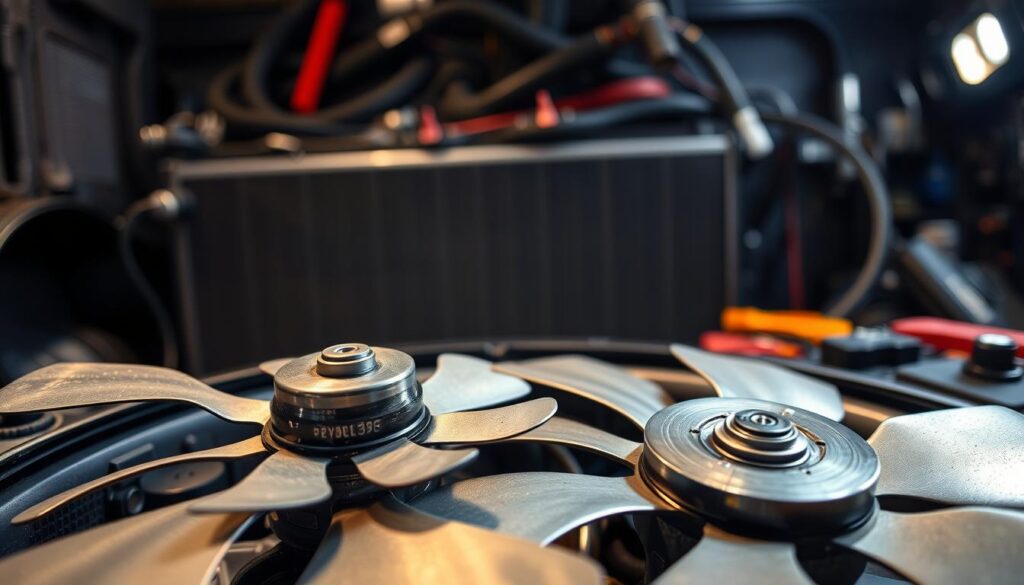
A vehicle’s cooling architecture controls heat flow from the engine to prevent damage. The assembly sits under the hood, directly behind the core, and boosts airflow through cooling tubes to keep temps stable.
The cooling system removes excess heat produced by combustion in the cylinders. Because the engine does not always need help, the fan does not run all the time while the car moves.
A thermostatic control engages the device when coolant reaches its safe maximum. Modern systems use multiple sensors to monitor coolant temperature and regulate motor operation automatically.
“Proper airflow through the core lets coolant lower engine temperature efficiently.”
Key points:
- Airflow through the radiator core is essential for heat transfer.
- Sensor-driven control saves energy and extends component life.
- Failure to cycle the device properly can lead to costly engine repairs.
| Component | Role | When It Runs |
|---|---|---|
| Cooling assembly | Moves air across core | At idle or high temp |
| Coolant circuit | Carries heat away from cylinders | Continuously during operation |
| Temperature sensors | Provide data to control unit | When temperature changes |
Signs Your Radiator Fan Is Not Working
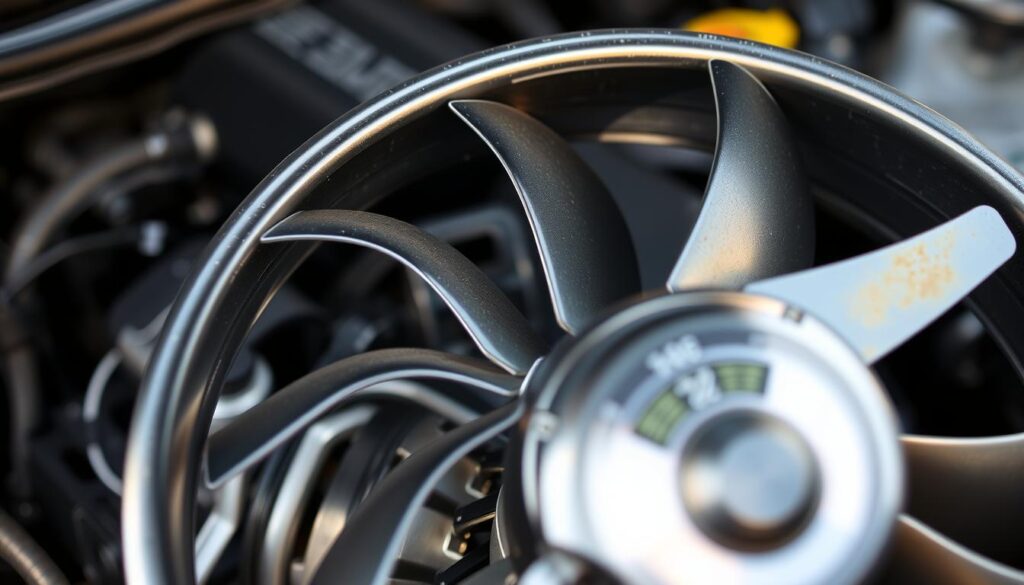
Early warning signs show up on the dash and under the hood. Watch the temperature gauge closely; a high reading is a primary indicator according to Natrad specialists.
Temperature Gauge Warnings
If the temperature rises quickly while the car idles, the cooling fan may be failing to move air across the core. A steady climb in temperature while stopped in traffic is a clear warning.
Air Conditioning Performance
When you switch the A/C to maximum cold and the cooling fan stays off, expect a problem. Reduced A/C output during slow speeds usually means the cooling fan or control circuit is not engaging.
“A high gauge reading or steam from the hood often signals immediate attention is needed.”
Quick checklist:
- Gauge spikes while idling
- Weak A/C at low speed
- Dashboard warning light or steam from the hood
| Sign | Likely Cause | Immediate Action |
|---|---|---|
| High temperature gauge | Cooling fan failed to engage | Stop and inspect coolant level |
| Poor A/C at idle | Fan control or relay issue | Have electrical check |
| Steam from hood | Engine heat not managed | Shut off engine and seek service |
Radiator Fan Not Working Overheating Fix
If a cooling device fails while driving, the safest first response is to pull over and shut the engine off.
Allow the engine to cool fully before any inspection. A hot engine can cause serious burns. Wait at least 30 minutes or until the temperature gauge returns to normal.
If the warning light comes on or the engine overheat continues after stopping, avoid driving further. Continued use can damage the motor, coolant passages, and other components.
Once cool, check electrical elements that let the fan turn on when the temperature rises. If the A/C runs but the fan does not turn, the issue likely sits in the control circuit or a relay.
Keep hands and tools clear of the assembly while the engine is hot or running.
Quick steps:
- Stop safely and turn off the engine.
- Wait for cooling before inspecting coolant and connections.
- Check electrical circuit if air conditioning runs but fan does not.
| Situation | Immediate Action | Next Check |
|---|---|---|
| Warning light on | Stop and shut engine | Wait to cool, inspect temperature and coolant |
| Temperature rising at idle | Pull over and let cool | Test motor power and relay |
| A/C cold but assembly idle | Do not drive | Check electrical circuit and fuses |
| Engine overheat persists | Tow to service | Contact a professional mechanic |
Safety Precautions Before You Begin
Always allow the engine to cool completely before inspecting the fan or any cooling parts. Hot coolant and metal cause severe burns.
Keep hands, loose clothing, and tools away from the moving fan assembly. Even at low speeds, blades can injure.
Disconnect the battery to prevent accidental activation of the fan while you test wiring. Wear gloves and eye protection for every inspection.
- Park the car on level ground and set the parking brake.
- Have a fire extinguisher nearby when working on electrical parts.
- Consult the vehicle owner’s manual for model-specific warnings and procedures.
Professional technicians at Natrad stress that safety is the top priority for any cooling unit task.
Quick reminder: if any step feels unsafe, stop and contact a trained mechanic or call BestCarShipping Inc. at (307) 288-5972 or email info@bestcarshippinginc.com for advice or transport arrangements.
| Precaution | Why It Matters | Immediate Action |
|---|---|---|
| Wait until cool | Prevents burns from hot coolant or metal | Allow 30+ minutes or until gauge drops |
| Disconnect battery | Avoids accidental blower activation | Remove negative terminal before work |
| Park level & secure | Prevents rolling and ensures safe access | Engage parking brake and chock wheels |
Inspecting the Fuse and Relay
Start troubleshooting at the power source: the fuse box and the relay that control the cooling circuit. These parts protect and deliver power to the motor and are easy to inspect safely.
Locating the Fuse Box
Refer to the vehicle manual to find the correct fuse and the fan relay locations. Most cars keep them in the main fuse box under the hood or inside the cabin. Mark the correct part before testing.
Testing for Electrical Continuity
Use a multimeter to check for 12V at the fuse holder. A blown fuse is the most common reason a cooling motor loses power.
- Listen for a click from the relay when the system tries to run. A click suggests relay action.
- Test relay continuity and swap with an identical relay if available. This isolates a bad relay quickly.
- If you find a blown fuse, replace it with the exact same rating. Do not use a higher-amp part.
“If both fuse and relay test good, the problem likely lies deeper in the wiring or control circuit.”
| Item | Check | Action |
|---|---|---|
| Fuse | 12V at holder | Replace with same rating if blown |
| Relay | Click and continuity | Swap with identical unit to test |
| Wiring | Continuity to motor | Inspect for breaks or corrosion |
If uncertainty remains, contact a professional. BestCarShipping Inc. can advise or arrange transport to a trusted service provider via info@bestcarshippinginc.com or (307) 288-5972.
Testing the Coolant Temperature Sensor
The coolant temperature sensor sends a signal to the engine control module to activate the radiator fan when the engine heats up. This switch must report accurate coolant temperature so the control system can engage the cooling device at the right moment.
If the sensor is faulty, the radiator fan may fail to engage and the engine can run hotter than intended. Owners may also see poor fuel economy or black exhaust smoke when the sensor gives incorrect readings.
Professional testing is recommended. A trained mechanic can verify sensor output and the engine control response. In some vehicles the sensor is a separate part; in others it is integrated into the engine computer.
Replacing a defective coolant temperature sensor is often cost-effective and restores proper fan control. Always ensure the engine is off and cool before any inspection to avoid injury from moving blades.
“Accurate temperature data keeps the engine control unit responsive and protects vehicle performance.”
- Have a technician test sensor voltage and resistance.
- Confirm the switch calibration matches manufacturer specs.
- Replace the unit when test results show out-of-range readings.
Need help? Contact BestCarShipping Inc. at (307) 288-5972 or info@bestcarshippinginc.com for advice or transport to a trusted service center.
Evaluating the Fan Motor and Wiring
A quick motor and wiring check often separates a simple replacement from a deeper electrical fault. Start with a visual inspection of the drive motor and its harness.
Look for obvious signs such as frayed insulation, burn marks, or loose connectors. Damaged wires may cause intermittent operation and are hard to trace without a meter.
If connectors are corroded, clean them and reseat firmly. Ensure ground points are tight. Poor contacts add resistance and can cause further damage to the motor or control circuitry.
When the wiring checks out but the motor fails to spin, the internal components have likely failed and the unit should be replaced. In most modern vehicles the fan motor is a cost-effective part to swap.
Some late-model cars use an engine-driven drive with a clutch. Inspect the belt and clutch assembly alongside the motor when applicable.
“Replace failed motors rather than attempt internal repairs; replacement restores reliable airflow and protects the engine.”
| Item | What to check | Action |
|---|---|---|
| Motor | Spin, noise, resistance | Replace if seized or noisy |
| Wiring | Fray, burn, loose pins | Repair or replace harness |
| Clutch/Belt | Wear or slippage | Service or replace as needed |
Need help with parts, repair options, or transport? BestCarShipping Inc. can advise and arrange service transfer. See estimated costs and logistics for related transport needs or call (307) 288-5972.
Checking Coolant Levels and Thermostat
Start with the reservoir—many temperature complaints trace to low fluid. Low coolant can stop the system from moving heat away and may look like a problem with the radiator fan.
Always check the tank with the engine cold. The fluid should sit between the “MIN” and “MAX” marks in your owner’s manual. Use a 50/50 mix of antifreeze and water for year-round protection.
Identifying Leaks
Inspect the hoses, reservoir, and visible seals for drips or crusty residue. Small leaks will lower coolant over time and cause a high temperature reading even when the fan is operating.
If levels drop after topping off, air may be trapped and the system needs bleeding. A stuck thermostat can stay closed and cause the engine to run hot despite proper fluid levels.
“Maintaining correct coolant keeps the cooling system and fan control effective.”
| Check | What to look for | Action |
|---|---|---|
| Reservoir level | Between MIN and MAX | Top with 50/50 coolant mix |
| Hoses & clamps | Soft spots, wetness, or residue | Replace or tighten as needed |
| Thermostat | Engine stays hot after warm-up | Test or replace if stuck closed |
| Air in system | Level drops soon after fill | Bleed system per manual |
If the temperature gauge stays high after these checks, consult a professional. For transport options while repairs are scheduled, learn how much to ship a car or contact BestCarShipping Inc. at (307) 288-5972 or info@bestcarshippinginc.com.
When to Seek Professional Mechanical Help
If dashboard warning lights persist or the cooling system shows signs of overheating, stop and call a professional. Driving on can cause severe engine damage and far higher repair costs than a timely service.
Contact a mechanic when:
- A persistent warning light appears and simple checks don’t solve the problem.
- You detect reduced air flow or repeated temperature spikes while idling.
- Electrical tests exceed your skill level or yield unclear results.
Certified technicians use diagnostic tools to find hidden faults within the radiator fan system. They can recommend the correct repair and follow manufacturer specifications to protect the engine.
“Towing the vehicle to a shop is safer than risking catastrophic engine failure.”
Cost-wise, professional repair often costs less than replacing an engine after severe overheating. For transport or advice, contact BestCarShipping Inc. at (307) 288-5972 or info@bestcarshippinginc.com.
Conclusion
Simple, regular maintenance prevents small cooling issues from becoming major repairs.
Owners should routinely inspect fuses, relays, wiring and coolant levels. These quick checks often catch problems early and keep the cooling system reliable.
If electrical faults or persistent overheating occur, seek professional mechanical help. Trained technicians diagnose complex faults safely and recommend the best repair or replacement path.
Prioritize safety: always cool the engine before any inspection and disconnect the battery when testing electrical parts. Following proper procedures reduces injury risk and further damage.
Well-maintained systems protect engine life and reduce roadside failures. For advice or transport to a trusted shop, contact BestCarShipping Inc. at (307) 288-5972 or info@bestcarshippinginc.com.