
Best Car Shipping Inc. helps U.S. buyers understand transport vehicle cost and pick a reliable auto shipping option at a fair price. Average national figures hover around $650 to $1,150, with a common range of $550–$2,450 depending on route and options.
Pricing varies by distance, car size, carrier capacity, and timing. Most cars go on open carriers; enclosed transport is chosen for high-value or classic models. A reputable provider will explain what the price includes, when payment is due, and which insurance applies.
Readers will learn national averages, per-mile benchmarks, route examples, and how to lower shipping cost without lowering service quality. For a clear quote and personal assistance, contact Best Car Shipping Inc. at info@bestcarshippinginc.com or call (307) 288-5972. Request a quote today for transparent rates and professional coordination.
Key Takeaways
- National averages range roughly $650 to $1,150; routes span $550–$2,450.
- Open carriers handle most moves; enclosed is for added protection.
- Price depends on distance, car size, carrier capacity, and timing.
- Reliable providers clarify what the shipping cost covers and insurance terms.
- Contact Best Car Shipping Inc. for a clear quote: info@bestcarshippinginc.com or (307) 288-5972.
What “transport vehicle cost” means for U.S. car shipping buyers

Understanding a quote starts with one clear fact: a quoted amount is the total fee to move a car from pickup to delivery using a licensed carrier network. Buyers should read the quote to see what the price covers and what it does not.
Typical price structures
There are two common models. A flat-rate quote gives a single price for the full move. Per mile pricing charges based on distance and is common for short runs or brokered loads.
What a quote usually includes
Most professional quotes list the assigned carrier, dispatch coordination, standard cargo insurance, and the pickup delivery plan. Door-to-door is offered when access allows.
Why the lowest price can be risky
Extremely low offers may hide exclusions or rely on thin carrier networks. Inoperable loading, oversized dimensions, rural access fees, and rush schedules often raise final charges.
| Quote Element | Typical Inclusion | Possible Exclusion | Buyer Check |
|---|---|---|---|
| Carrier | Assigned licensed carrier | Specific carrier name | Ask who hauls your car |
| Insurance | Standard cargo coverage | Damage limits/exclusions | Confirm coverage details |
| Pickup & Delivery | Door-to-door when accessible | Rural or restrictive access | Verify exact pickup/delivery points |
| Fees | Fuel and basic handling | Winch, oversized, or expedited fees | Ask about final payment timing |
Buyer checklist: Ask if the price is guaranteed, when payment is due, and how claims and inspections work. The goal is safe, on-time delivery with clear communication—not just the lowest line item.
Average cost ship car pricing in the U.S. right now
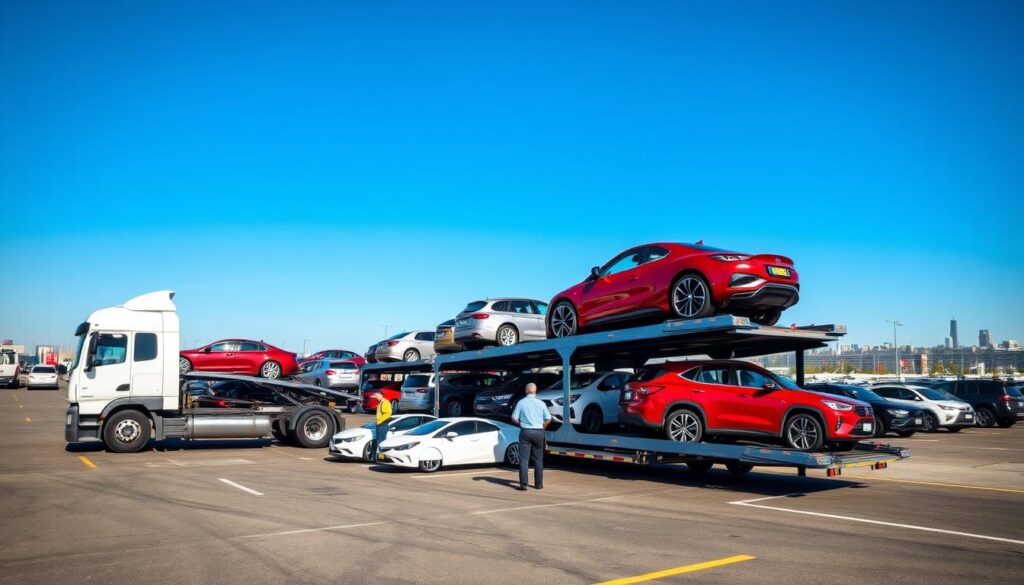
National snapshot: Current U.S. pricing typically falls between about $500 and $2,000. Most consumers pay in a middle band near $650 to $1,150, depending on route mix and service level.
Common national averages and real-world ranges
Open carriers are the baseline for published averages. Enclosed or expedited services sit above that baseline.
Short studies often show lower totals but higher per-mile figures. Long-haul lanes lower the per-mile number but raise the total price.
Per mile benchmarks to expect by shipment length
Short trips under 500 miles cost more per mile. Mid-range moves often offer the best per-mile value. Cross-country runs usually drop to a lower per-mile rate while increasing the total price.
What causes a quote to land at the low or high end
Quotes shift with metro-to-metro lanes, rural pickup or delivery, seasonal demand, fuel swings, and carrier availability. Trailer capacity and timing windows also push prices up or down.
| Factor | Typical effect | Buyer action |
|---|---|---|
| Distance | Short: higher per mile; Long: lower per mile | Compare per-mile and total price for the same lane |
| Service type | Open baseline; enclosed/expedited add premiums | Choose open when protection needs are standard |
| Access & timing | Rural or tight windows raise rates | Provide exact pickup/delivery details for apples-to-apples quotes |
| Market demand | Peak season and low carrier capacity increase prices | Book early or remain flexible on dates |
Practical tip: Ask for identical quote inputs—same car, same dates, same pickup/delivery type—to compare rates fairly. Budget for quality: clear insurance, inspection procedures, and reliable communication reduce risk and delays.
Car shipping cost per mile by distance
Per-mile benchmarks shift a lot with distance, and that shift is key when evaluating any car shipping quote.
Short routes under 500 miles typically run about $1.55–$2.50 per mile. These moves show higher per-mile rates because fixed loading, dispatch, and minimum revenue needs spread over fewer miles.
Mid-distance lanes (501–1,000 miles and 1,001–1,500 miles) often hit the pricing sweet spot. Expect roughly $1.00–$1.45/mile for 501–1,000 and $0.80–$1.10/mile for 1,001–1,500.
Long and cross-country trips fall to $0.65–$0.90/mile for 1,501–2,000 miles and lower beyond that. Per-mile rates dip due to lane density, but total shipping and time on the road rise accordingly.
Sample routes: NYC→Miami ~$1,100–$1,400; NYC→LA ~$1,325–$1,625; LA→NYC ~$1,350–$1,925; Chicago→Phoenix ~$1,050–$1,225. Final pricing depends on car size, timing, and pickup/delivery limits. State-to-state demand (snowbirds, school moves, relocations) also shifts rates quickly.
Buyer action: Request a written quote with exact ZIP codes and a pickup window. For quick comparison, see a reliable cheap car shipping option and secure transparent pricing.
Open transport vs enclosed transport pricing breakdown
Deciding between open and enclosed hauling starts with a clear look at risk versus budget. Open transport is the standard, cost-effective choice used for most everyday car shipping lanes. It suits common sedans and SUVs when basic protection is acceptable.
Average open carrier costs by distance
Typical open carrier averages: under 500 miles ~$630; 500–2,500 miles ~$1,135; over 2,500 miles ~$1,350. Open options use higher-capacity trailers and more frequent lanes, so prices stay lower.
Average enclosed carrier costs by distance
Enclosed averages: under 500 miles ~$930; 500–2,500 miles ~$1,550; over 2,500 miles ~$1,830. Expect roughly a 40–50% premium due to fewer trailers and limited carrier availability.
When enclosed transport is worth the extra protection
Choose enclosed if the car is high-value, classic, or has aftermarket finishes. Low ground clearance, recent paint, and rare parts increase the benefit of added protection.
- Operational reasons: fewer carriers, fewer cars per trailer, and stricter handling raise enclosed pricing.
- Expectation: enclosed reduces exposure but doesn’t remove all risk—document condition with photos and an inspection report.
Compare side-by-side: Best Car Shipping Inc. will provide both service quotes so buyers evaluate value, not just prices. Get a clear written quote and compare averages and protections today via average per-mile benchmarks.
How vehicle type changes vehicle shipping prices
Not all cars occupy the same trailer slot; size, height, and weight change how carriers plan a load and set prices.
Sedan vs compact SUV vs SUV vs truck
Small sedans usually use one standard slot and show the lowest averages: $425 / $725 / $925 for
Compact SUVs rise slightly. Expect roughly $455 / $775 / $1,025. Full SUVs add weight and height, moving to $505 / $825 / $1,075.
Trucks need more space and tie-downs and typically cost the most at $575 / $925 / $1,275 across the same bands.
Oversize and modified cars
Lift kits, wide tires, roof racks, or extended beds can change measurements and use extra trailer slots. That triggers higher rates and special handling.
Buyers should fully disclose make, model, and modifications. Accurate info avoids re-quotes and delays at pickup.
Motorcycles, luxury cars, and specialty needs
Motorcycles require dedicated securement and different loading gear. Luxury or classic cars often justify enclosed transport for extra protection.
Choosing experienced carriers and the right equipment lowers damage risk and preserves delivery timelines. For enclosed options and specialized services, see enclosed shipping.
Key factors that drive auto transport costs beyond mileage
Beyond miles, several operational elements shape final auto transport quotes. Mileage matters, but real rates reflect route efficiency and handling complexity.
Pickup and delivery locations
Metro-to-metro lanes are denser and usually cheaper. Remote pickup or delivery points add time and labor and can raise charges.
Operable vs. inoperable condition
If a car cannot roll or steer, carriers often require winch or forklift help. That adds fees and handling steps to the shipment.
Speed, windows, and market pressure
Flexible pickup windows let dispatch pair loads efficiently. Expedited requests push pricing higher when demand is tight.
Fuel, carriers, weather, and industry shifts
Fuel swings and carrier availability change daily. Severe weather conditions reduce capacity and increase delays. New regulations and GPS-driven operations also alter overall pricing over time.
| Factor | Typical impact | Buyer action |
|---|---|---|
| Access (metro vs rural) | Higher for remote pickups | Provide exact ZIP codes |
| Operable condition | Winch/forklift fees if inoperable | Ensure operable or declare condition |
| Timing & demand | Expedited = premium | Be flexible on dates |
| Weather & regulation | Potential delays and compliance charges | Plan buffer time and confirm coverage |
Bottom line: Ask carriers for a written quote that lists these factors. Clear inputs mean fairer pricing and fewer surprises on delivery.
Seasonal pricing guide for shipping car in the United States
Seasonal shifts change how and when people move cars, and understanding these cycles helps plan better. Demand, driver availability, daylight, and weather all affect carrier schedules and final rates.
Winter realities
Late winter often shows lower demand and softer prices for shipping car lanes. February can be one of the slowest months.
Warning: snow and ice raise delay risk and longer transit time. Buyers should weigh lower prices against potential schedule slippage.
Spring transition
Spring brings improving roads and more carriers on the road. Northbound demand can push rates up on some state-to-state lanes.
Book early if moving during high-turn seasons to lock in favorable rates and delivery windows.
Summer peak and fall steadiness
Summer is the busiest time for car shipping. Relocations and school moves tighten capacity and push prices higher.
Fall usually offers steadier availability and often lower prices than summer. Weather is milder and delays are less frequent.
Planning tip: The best time to ship depends on lane direction and desired delivery time. For an updated, lane-specific quote, request current rates at how much it costs to ship a.
Pickup delivery options that affect shipping cost
Pickup and delivery choices shape how carriers plan routes and allocate time. Accessibility at both ends influences routing, driver stops, and final price. Small differences in access can add mileage or delay loading.
Door-to-door vs. meeting in an open area
Door-to-door means the carrier attempts pickup and delivery as close to the address as legally and safely possible. This is the most convenient option for most customers.
When streets are narrow or access is restricted, carriers often request a nearby open spot. A large parking lot or wide street reduces loading time and risk. That approach can prevent hold-ups and protect the car.
Urban access advantages and rural surcharges
Metro areas typically have more frequent runs and lower rates. Rural pickups add deadhead miles and scheduling complexity. That often leads to higher charges for remote addresses.
- Examples: gated communities, low bridges, HOA rules, narrow lanes that block large trailers.
- Practical tip: offering a flexible meeting point can lower the shipping cost without reducing service quality.
- Best practice: confirm pickup feasibility before dispatch to protect timelines and avoid surprise fees.
Ready for a firm quote? Get a detailed pickup and delivery estimate through Best Car Shipping Inc. by requesting a personalized pickup delivery quote.
Expedited shipping and guaranteed-date services: what you’ll pay for speed
When deadlines matter, expedited shipping shortens pickup windows and prioritizes your load on the road.
Expedited shipping means narrower pickup windows, priority dispatch, and limited routing options for carriers. That reduced flexibility is why premium fees apply.
How extra speed raises your total
Carriers accept premiums to reroute, hold space, or meet firm dates. Those moves increase labor and scheduling complexity, so the shipping price rises.
Three common service tiers
- Standard open: Best value for flexible dates and routine deliveries.
- Expedited open: Faster pickup-delivery windows with priority dispatch.
- Enclosed premium: Top speed plus added protection for high-value car transport.
When to choose faster service
Use expedited options for job relocation deadlines, auction pickup, military reporting, or dealer inventory needs. If you can shift delivery by a few days, standard service often saves money.
Get a side-by-side quote from Best Car Shipping Inc. to compare standard vs expedited options and confirm guaranteed-date terms. Request a clear price estimate or call info@bestcarshippinginc.com / (307) 288-5972.
How to get the best quote for vehicle transport without hidden fees
An accurate quote starts with precise inputs and clear questions. Enter exact ZIP codes, car make and model, operable status, and whether you want open or enclosed service. Add the earliest pickup date to give carriers scheduling context.
What to enter in a car shipping calculator for accurate pricing
Provide pickup and delivery ZIPs, vehicle size/type, operable condition, and service choice (open vs enclosed). Note special needs like low clearance or oversized wheels. These details reduce re-quotes and surprises.
How to compare quotes apples-to-apples across services
Match the same service level, identical pickup/delivery points, and the same insurance assumptions. Confirm transit windows and any added fees. Ask each carrier for a written, itemized quote.
Spotting red flags and payment transparency
Watch for rates far below market averages, vague insurance language, and no written terms. Ask how deposits and final payment work. Reputable firms document deposits, show final price timing, and explain refund rules.
Next step: Request an itemized quote from Best Car Shipping Inc. via info@bestcarshippinginc.com or call (307) 288-5972 to confirm transparent pricing and reliable service.
Ways to lower your car transport cost without sacrificing service
Simple planning moves—like earlier booking and flexible pickup windows—sharpen options and lower premiums.
Book early. Early requests attract more carriers and reduce the need for expedited scheduling. That stabilizes pricing and improves carrier choice. Consider a firm plan weeks before move time and book early to lock in rates.
Stay flexible on pickup and delivery dates. A wider window lets dispatch pair loads efficiently. Flexibility often produces lower rates and faster pickups.
Choose open transport when protection isn’t required. Open trailers reduce rates for everyday cars. Use enclosed protection only for high-value cars that need extra shielding.
Keep the car operable. Ensure it rolls, steers, and brakes. Inoperable units need winches or forklifts and add fees and delays.
“Saving a few dollars is worthwhile only if the carrier still provides clear communication, inspection, and on-time delivery.”
- Ask about discounts: military, students, seniors, and multi-car shipments.
- Compare written quotes and confirm pickup details to avoid surprises.
Practical reminder: The cheapest line item can cost more if it increases delay risk or reduces accountability. Contact Best Car Shipping Inc. at info@bestcarshippinginc.com or (307) 288-5972 for a balanced quote.
What “safe shipping” really costs: insurance, liability, and protection options
Safe shipping means documented condition, appropriate carrier insurance, and a clear liability process. Buyers should get written limits, exclusions, and a claim procedure before pickup.
Standard cargo insurance basics
Most professional quotes include standard cargo insurance. Confirm the coverage limit and any exclusions related to weather or roadside events.
Ask for: coverage amount, claim contact, and deductible details. Keep these items on the Bill of Lading at pickup.
Extra protection and gap options
Higher-value cars may need additional protection. Enclosed transport reduces exposure and optional gap coverage can cover value differences after a total loss.
Pre-pickup and delivery inspections
Document condition with dated photos and detailed notes. Clean the car for visibility and confirm pre-existing damage on the Bill of Lading.
At delivery, inspect immediately and note any new damage before signing. Prompt claims and clear records protect the owner and vendor.
| Protection Element | What to Confirm | When to Add | Buyer Action |
|---|---|---|---|
| Standard cargo | Limit, exclusions, claim process | All shipments | Get written limits |
| Enclosed service | Trailer type, handling rules | High-value or classic cars | Request enclosed quote |
| Gap/add-on plans | Coverage amount and terms | New or financed cars | Compare plan details |
| Inspection/BOL | Photos, signatures, notes | Pickup and delivery | Retain copies for claims |
Conclusion
Final pricing and satisfaction hinge on combining route-specific quotes with careful service choices. Use national averages (~$500–$2,000) as planning benchmarks, then get a written quote for your lane.
Understand per-mile trends, decide open vs. enclosed transport, confirm pickup delivery details, and verify insurance. Those steps protect value and set clear expectations.
Remember: outcomes depend on more than distance — demand, carrier availability, and weather influence final rates and timing.
For transparent rates and protection-first coordination, contact Best Car Shipping Inc. at info@bestcarshippinginc.com or (307) 288-5972. Request a written quote and choose the option that delivers the car safely and on schedule.