
When freezing temperatures hit, a vehicle that fails to turn over is often a battery issue. Sonoma County ASE technicians report that 60% of cold-season no-starts stem from a dead or weak battery. At 0°F, batteries can lose up to 50% of their power, making reliable maintenance essential.
Our emergency service center at 305 Laguna Dr, Rohnert Park offers professional diagnostics and repair. ASE-certified staff with nearly 30 years of local experience test batteries, alternators, and the entire electrical system. They pinpoint whether dim dashboard lights or a clicking noise mean a battery replacement or deeper system repair.
Preventive maintenance matters. Keeping the battery, ignition, and coolant at the right levels reduces the risk of being stranded. Thick engine oil and low power demand two to three times more effort to turn the engine during freezing spells, so timely service avoids roadside delays.
Key Takeaways
- Most no-starts in cold weather are due to weak batteries; test early.
- Batteries can lose up to 50% power at 0°F; plan winter checks.
- Dim lights or clicking often signal the need for battery or system repair.
- 305 Laguna Dr, Rohnert Park provides local, ASE-certified diagnostics.
- Regular maintenance of battery, ignition, and coolant prevents winter failures.
Why Cold Weather Impacts Vehicle Performance
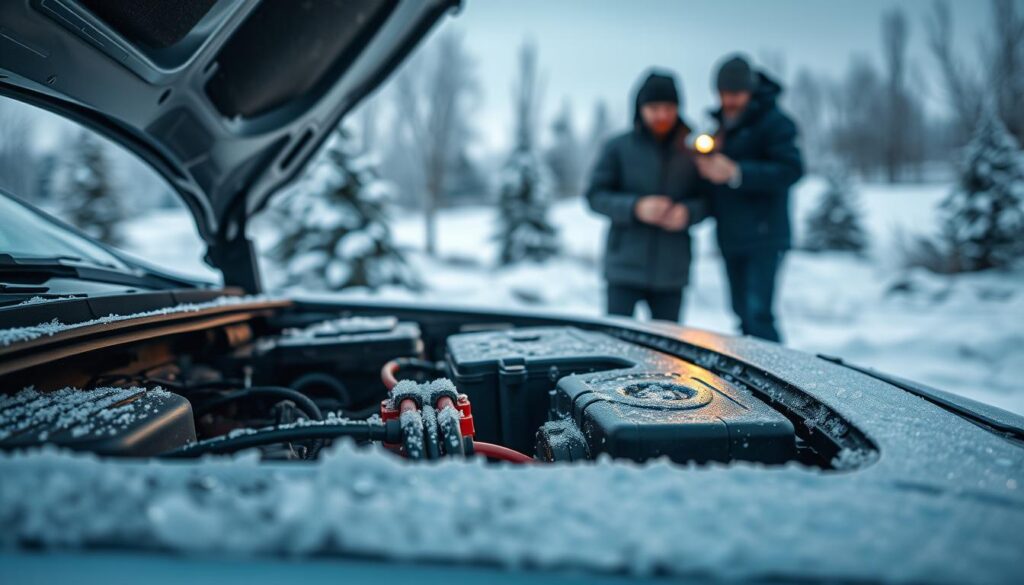
Winter brings a predictable mismatch between available electrical power and engine demand. At 0°F a typical battery delivers about half its rated capacity. That loss combines with a starter that must overcome increased resistance.
The engine needs two to three times more cranking force when oil thickens. Thick lubricant slows moving parts and forces the starter to draw much more power.
“Most starting problems happen because the battery cannot supply enough current to overcome internal resistance.”
- Chemical reactions inside the battery slow as temperatures fall, cutting cranking power.
- Electrical resistance rises across terminals and cables during freezing spells.
- In Sonoma County foothills, temperatures can reach the 25–30°F range where starting problems appear.
Actionable point: Test the battery and select correct oil viscosity before the first deep freeze. Proper preparation prevents the majority of winter starting problems.
Common Reasons Your Car Won’t Start in Cold Weather
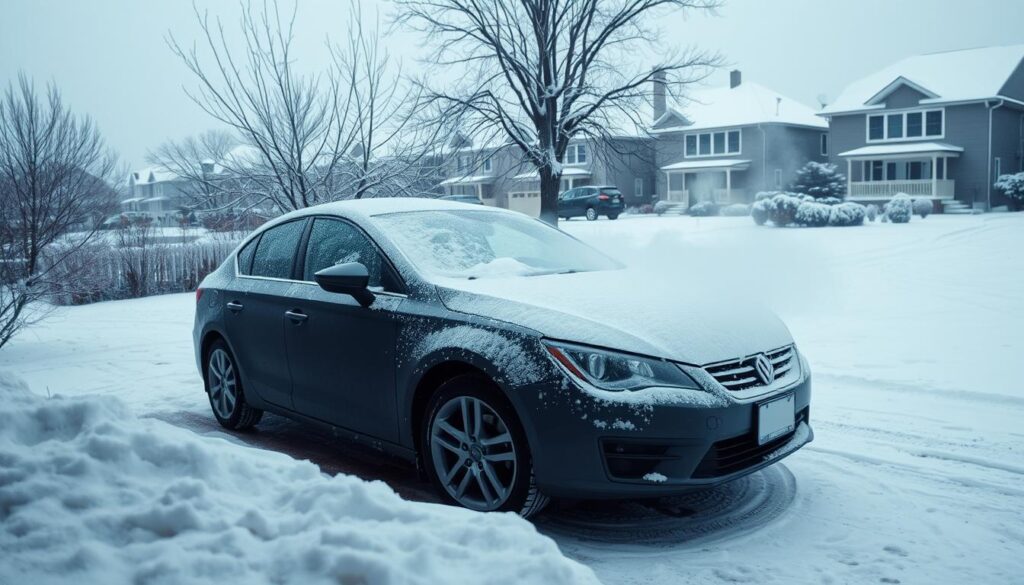
Low temperatures expose weak points in a vehicle’s electrical and fuel systems.
Electrical System Failures
Battery weakness is the most frequent issue that prevents a reliable car start cold. Corrosion on terminals acts like an insulator and stops current from reaching the starter.
A failing alternator or a worn starter can also halt operation despite adequate battery voltage. Moisture that invades the ignition system causes misfires during damp, foggy conditions common locally.
Mechanical Resistance
Thickened oil raises crank resistance. The engine needs more torque at low temperatures, so a weak battery or stressed starter struggles to turn it over.
- Frozen fuel lines form when water in the tank freezes at 32°F and blocks flow.
- Keeping the tank above 1/4 reduces condensation and related blockages.
- Single loud click on key turn often signals solenoid engagement without sufficient motor power.
| Symptom | Likely Cause | Quick Check |
|---|---|---|
| Dim lights, slow crank | Weak battery | Load test or voltage check |
| Clicking sound | Corroded terminals or low charge | Inspect terminals; clean and tighten |
| No fuel flow | Frozen fuel lines | Warm area and inspect fuel delivery |
The Role of Battery Capacity in Winter
Battery capacity falls sharply as temperatures drop. At 80°F a standard lead-acid unit delivers full rated power. By 0°F capacity can fall to about 50%, and at -20°F it may drop near 40%.
A 600 CCA battery at room temperature might only supply roughly 300 CCA when the mercury hits 0°F. That reduction explains why a weak battery often fails during the first cold weather event.
- Temperature matters: chemical reactions slow, lowering available amps.
- Higher engine demand: the starter and engine need a larger surge to crank during freezes.
- Age and charge: batteries older than 4–5 years or a weak alternator commonly cause problems.
- Protection helps: parking in a garage and regular CCA testing preserves service life.
Drivers should have a professional measure CCA output and check the charging system. Our technicians use industry-grade testers to confirm whether a battery or alternator requires service.
Engine Oil Viscosity and Starting Challenges
Viscosity of engine oil plays a major role when temperatures drop. Thicker oil raises internal friction and makes the engine harder to crank.
Choosing the right grade reduces strain on the battery and starter and improves first-turn reliability.
Choosing the Right Winter Grade
Conventional 10W-30 at 0°F is four to five times thicker than at 80°F. That extra thickness increases starter load by roughly 30–40%.
Switching to synthetic 0W-20 or 5W-30 lets oil flow freely at low temperatures. That change cuts resistance and helps the start engine sequence require far less power.
Practical tips:
- Use manufacturer-recommended winter-grade synthetic oil for vehicles from 2015 onward.
- Change oil regularly; old oil thickens faster and worsens starting problems.
- For frequent driving where temperatures fall below 32°F, choose a low-viscosity synthetic.
| Oil Type | Low-Temp Flow | Effect on Starter |
|---|---|---|
| 10W-30 (conventional) | Poor at 0°F | Increases load 30–40% |
| 0W-20 (synthetic) | Excellent at 0°F | Reduces starter effort |
| 5W-30 (synthetic) | Very good at 0°F | Improves cold turning |
Our service team can recommend the correct oil and perform an oil change to protect your battery, alternator, and starter. Contact info@bestcarshippinginc.com or call (307) 288-5972 for tailored guidance.
Fuel System Issues and Frozen Lines
Water trapped in fuel lines turns to ice at 32°F and can block flow to the engine.
Fuel system issues are common during freezing temperatures. Moisture condenses inside the tank and then freezes, forming plugs that stop fuel delivery.
If the vehicle cranks but will not fire, frozen fuel lines are a likely cause—especially after running near-empty. Keeping the tank above one-quarter full reduces air space and limits condensation.
Preventive steps matter: use fuel-line antifreeze or approved additives to keep water from freezing. Diesel setups need anti-gel treatments to prevent thickening and stoppage.
- Never pour hot water on filters; thermal shock can crack the housing and cause leaks.
- If freezing is suspected, tow the vehicle to a heated garage to thaw safely.
- Technicians can inspect for contamination or moisture and clean the system to restore reliable operation.
Contact our team at info@bestcarshippinginc.com or (307) 288-5972 for a fuel-system check before temperatures drop further.
Ignition System and Spark Plug Problems
Moisture on spark plug wires or ignition coils can bleed current to ground. That prevents a spark at the cylinder. The result is an engine that cranks but will not run.
Worn plugs or damaged coils struggle when the battery is weak or oil is thick. Misfires or sputtering after a cold morning usually point to ignition issues.
- Inspect wires for cracks and corrosion.
- Use electrical contact cleaner to remove moisture.
- Apply dielectric grease to spark plug boots to seal connections.
Replace spark plug wires every 60,000–100,000 miles. Technicians can test coils and plugs to find hidden faults before they cause a no-start event. A healthy ignition system reduces load on the starter and alternator, improving starting reliability.
| Symptom | Likely Cause | Action |
|---|---|---|
| Cranks but won’t run | Moisture or faulty coils | Dry and test ignition components |
| Misfire after cold start | Worn plugs or dirty boots | Replace plugs; apply dielectric grease |
| Intermittent sparks | Damaged wires | Replace wires (60k–100k miles) |
Need help? Contact the shop at info@bestcarshippinginc.com or call (307) 288-5972 for professional ignition testing and winter preparation.
Professional Car Won’t Start in Cold Weather Fix
A trained technician finds the root cause fast and explains repair options in plain language.
Comprehensive diagnosis: the shop tests the battery, starter, and alternator to isolate electrical or fuel system problems. Typical starter or alternator repair takes about 1–2 hours, depending on engine bay layout.
Transparent pricing guides every step. Technicians quote needed parts and labor before any work begins. This helps owners make informed decisions and avoid surprise bills.
Mobile service is available for roadside assistance. If towing is required, the team moves the vehicle to the garage and begins repairs quickly.
- Nearly 30 years of Sonoma County experience handling simple replacements and complex engine repairs.
- Preventive maintenance recommendations to reduce winter starting problems and protect the battery and oil system.
- Specialized tools ensure efficient, correct repair for most makes and models.
Call (707) 584-7727 to schedule service or request mobile support. Clear communication and reliable repair keep drivers moving.
Essential DIY Jump Starting Techniques
Handling a dead battery at the roadside requires care and a methodical approach. Follow safety steps first, then make connections in the correct order to protect the electrical system.
Safety Precautions for Cables
Inspect the battery before touching cables. If the battery is cracked, swollen, or leaking, do not attempt a jump; arrange a professional replacement.
Turn off all accessories—lights, heater, radio—to maximize available power for the starter.
Proper Connection Sequence
- Attach the red clamp to the positive terminal of the good battery, then to the positive of the dead unit.
- Attach the black clamp to the negative terminal of the good battery.
- Do not connect the black clamp to the dead battery’s negative post. Instead, clip it to unpainted metal on the engine block as a ground.
- Once started, let the engine run for at least 30 minutes so the alternator can restore charge.
- If the vehicle fails to start after 2–3 attempts, suspect a faulty starter, alternator, or weak battery and seek professional service.
Cleaning corrosion from terminals improves connection and raises success rates. Keep quality jumper cables or a portable jump starter on hand during winter. For assistance, contact info@bestcarshippinginc.com or call (307) 288-5972.
Cleaning and Maintaining Battery Terminals
A clean terminal connection is an inexpensive step that prevents many starting problems.
Begin by disconnecting the negative terminal first with a 10mm wrench. This prevents accidental short circuits during service.
Mix 1 tablespoon of baking soda with 1 cup of water and apply with a brush. Scrub the white or green crust until metal is visible. Rinse and dry before reconnecting.
“Corrosion acts like an insulator; cleaning terminals restores full current flow to the starter and alternator.”
- Use a wire brush and the baking soda solution to remove buildup.
- Apply a thin film of petroleum jelly or a terminal protector spray to slow future corrosion.
- Tighten loose clamps; poor contact causes intermittent faults and failed car start attempts.
| Tool | Use | Result |
|---|---|---|
| 10mm wrench | Disconnect negative first | Reduces short risk |
| Wire brush | Scrub terminals | Restores contact |
| Baking soda mix | Neutralize corrosion | Clean metal surface |
Regular maintenance keeps a vehicle reliable through winter. For professional cleaning, testing, or battery replacement and repair, visit Connecticut vehicle shipping for service options.
When to Seek Professional Automotive Repair
A single failed jump or strange grinding noise often signals a deeper mechanical or electrical fault. If basic attempts do not restore reliable operation, professional diagnosis prevents further damage.
Call for emergency roadside support at (707) 584-7727 if you hear grinding or repeated clicking, or if the vehicle starts then dies immediately.
- Seek repair after 2–3 jump attempts fail; this often means the battery, starter, or alternator has serious problems.
- A battery warning light that remains on while driving suggests alternator failure and imminent loss of power.
- Grinding metal-on-metal when the key turns indicates a failing starter that may need immediate replacement.
- If the engine fires then stalls, suspect fuel flow or a sensor that affects the air/fuel mixture.
- Vehicles with batteries older than four years should get professional replacement to avoid repeated no-start events.
“Professional diagnostics identify whether the issue is battery, fuel delivery, or ignition so repairs target the root cause.”
Our Rohnert Park shop offers comprehensive battery testing and charging system analysis. For appointments or urgent help call (707) 584-7727 or email info@bestcarshippinginc.com. Prompt service reduces downtime and protects your vehicle.
Conclusion
Simple seasonal checks, help prevent morning failures during freezing months. Regular battery tests, proper oil selection, and keeping fuel topped reduce the risk of a no-start when temperatures fall.
Cold weather reduces battery capacity and thickens oil, making each ignition attempt a true test. Prepare before the first deep freeze to avoid roadside delays and costly repairs.
If persistent starting problems occur, trust professional diagnostics. For details on related services and transport pricing, visit average cost to ship a vehicle per or contact the team at info@bestcarshippinginc.com or (307) 288-5972.